
Keyword targeting is one of the foundations of SEO. Whether you’re writing a blog post, creating a service page, or publishing a product description, choosing the right keywords helps search engines understand your content and connect it with the people searching for it.
Understanding keyword targeting isn’t about trying to game Google’s algorithm or stuffing your content with the same phrase over and over again. Instead, it’s about creating relevant, helpful content that answers your audience’s questions while signaling to search engines what your page is about.
In this guide, we’ll explain what keyword targeting is, why it matters, how to choose SEO target keywords, and where to use them to improve your visibility in search results.
You may also be interested in: Is SEO worth it for small businesses?
What is keyword targeting?
Keyword targeting is the process of selecting a primary keyword or phrase that you want a webpage to rank for and strategically optimizing the page around that keyword. It’s selected to align with the topic or theme of the content. In essence, it’s the term you want your content to be associated with when people search online.
Your target keyword should reflect what your audience is actually searching for. Naturally incorporating it into your content, headings, page title, URL, image alt text, and meta description makes it easier for search engines to understand your content and determine when it should appear in search results.
Why are target keywords important for SEO?
Target keywords help connect your content with the people looking for it. Without a clear target keyword, search engines may struggle to understand the primary focus of your page.
Effective keyword targeting can help you:
- Improve your visibility in search results
- Attract visitors who are genuinely interested in your products or services
- Create more focused, relevant content
- Support your overall SEO strategy
- Increase the chances of appearing in AI-generated search results and featured snippets
Remember, keyword targeting is just one piece of the SEO puzzle
Google considers hundreds of ranking factors—including content quality, user experience, backlinks, website performance, and search intent—when deciding how to rank a page. Keyword optimization is an important one, but simply using keyword targeting doesn’t mean that your content will instantly shoot to position one.
Take this blog post, for example; we’re writing it because we know many small businesses struggle to understand what keyword targeting is and how it works. Of course, we would love nothing more than for new audiences to find out about our agency by clicking on the article (sitting at position one) when they Google “what is keyword targeting in SEO?” But that kind of thinking would be overly optimistic.
For one, our website is several years old, established but lacking the longevity of competing sites. Although we provide quality content and have a technically sound website, our domain isn’t yet seen by search engines as a stalwart of informative and relevant content. As a small business, we’re not a household name, so we don’t have millions of other websites and social profiles linking back to ours as a trusted resource. We’re also competing with some big names like Wordstream, Hubspot, and Semrush.
But we’re not writing for algorithms and bots; we’re writing for you—small business owners and marketers who want to learn how to make marketing work with the limited time and resources you have at your disposal.
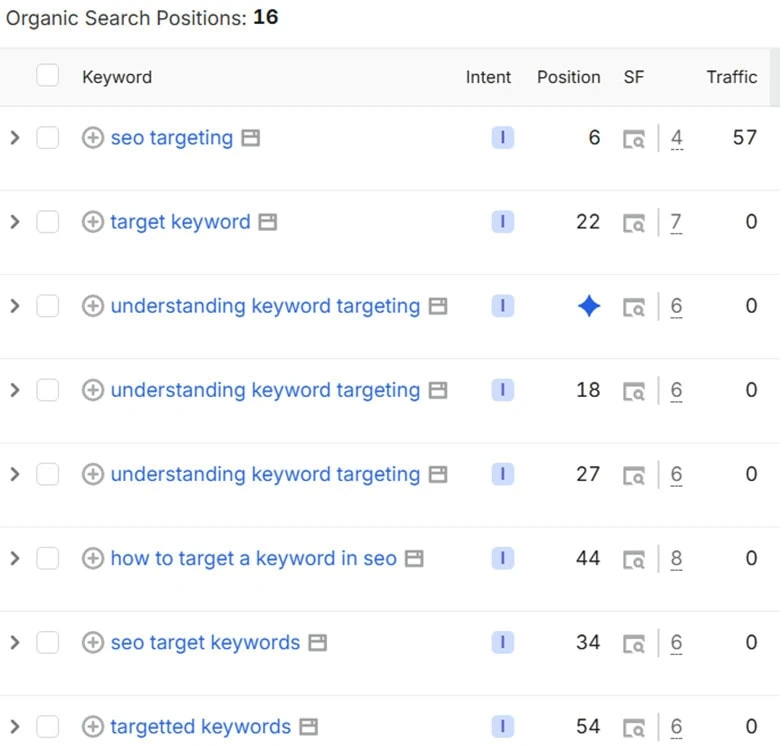
UPDATE: The blog was originally published in 2024, and, as it turns out, it’s performing pretty well on search (now looking at results in 2026), even a possible page one result for the term “SEO targeting”. Although this wasn’t the keyword we set out to rank for, Google understood what we’re trying to get across, and we’re earning traffic as a result!
Now, let’s get into how you can do the same!
How does keyword targeting work?
In SEO, keyword targeting is like playing matchmaker between your content and what people type into search engines. You do some research to figure out what words or phrases your target audience is likely to use when looking for topics related to your site. Then, you strategically sprinkle those keywords throughout your content—in titles, headers, and naturally within the text. When search engines crawl your site and see that your content aligns with what users are searching for, they’re more likely to serve it up in search results.
The process typically looks like this:
1. Start with your audience
Ask yourself:
- What questions are my ideal customers asking?
- What problems are they trying to solve?
- What would they type into Google?
2. Research keywords
Once you have a few ideas, use a keyword research tool to explore related searches. Ideally, you’re looking for keywords with reasonable search volume and lower competition. Keep in mind that keyword data is always an estimate—every user has a personalized search experience.
3. Consider search intent
Before selecting a keyword, ask yourself: What is the person hoping to find when they search for this?
- Someone searching “what is keyword targeting” wants a definition
- Someone searching “how to target keywords in SEO” wants practical guidance
Matching your content to the searcher’s intent is often more important than choosing the keyword with the highest search volume.
4. Include semantic keywords
Instead of repeating your primary keyword dozens of times, support it with related words and concepts. Semantic keywords help search engines understand the broader context of your content while making your writing sound more natural.
Let’s look at a real-life example of keyword targeting
In this blog post, our primary target keyword is “understanding keyword targeting” (ha, a great opportunity to insert it naturally in the copy!). But we suggest using a couple of semantic keywords, too. Instead of focusing solely on exact-match keywords, semantic keywords allow search engines to comprehend the broader meaning of a piece of content.
A semantic keyword encompasses related words, synonyms, and concepts. In the context of search engines and SEO, semantic keywords are used to improve understanding of the content’s context and relevance. In this blog, supporting semantic keywords include:
- keyword targeting
- SEO target keywords
- target keywords for SEO
- how to target keywords in SEO
These related phrases help search engines understand the broader topic without repeating the same wording throughout the article.
But how do we come up with target keywords in the first place?
Target keyword research option 1: Semrush
My keyword research process usually starts in Semrush, a popular keyword research and SEO platform.
- I type the keyword I have in mind into the Semrush search bar and see what broad-match keywords and questions it returns
- I look at the volume to see how many people search for that particular keyword per month*
- The keyword difficulty (KD) gives me an indication of how difficult the keyword would be to rank for, i.e. how competitive it is*
- Ideally, I’m looking for keywords with high volume and low keyword difficulty, which means lots of people are searching for that target keyword, but not many other websites are providing content that answers their query (hooray for low competition!)
*Bear in mind that these are estimates provided by Semrush, as everyone has a personalized search experience

From the list provided by Semrush, I narrowed down the relevant keywords for this blog post to:
- “what is keyword targeting”
- “what is a target keyword”
- “what is keyword targeting seo”
“What is keyword targeting” had a fairly high keyword difficulty of 50%, which is why I went with “what is keyword targeting seo” as the primary keyword (not pictured above, but the KD was 0). Bonus that it includes the higher volume keyword anyway.
You may also be interested in: Our 13 best apps for small business owners
That said, you don’t need to pay for a tool like Semrush to come up with target keywords and phrases. There are other (free!) methods to help you arrive at a similar end.
Target keyword research option 2: People also ask snippets

When I’m finished researching in Semrush, I’ll also enter the target keyword into the Google search bar to see related questions that people ask about this topic. Answering these questions enriches the article for the target audience, adds more semantic keywords, and also increases the chances of my answer appearing as a snippet answer in the search results, like this:
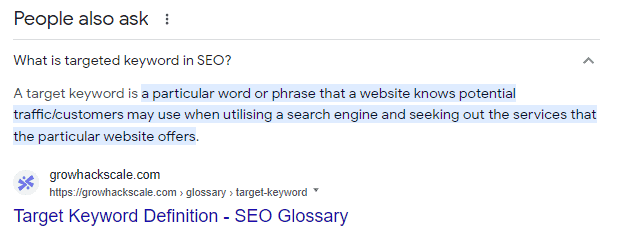
See if you can spot the answers in this article!
You can simply use Google for keyword research, although you won’t get the same data about search volume and ranking difficulties that you get from a paid tool. The simplest method is to Google your subject and see what comes up. With a few pointed searches and some time spent in the People Also Ask queries, you’ll gain new ideas that likely weren’t part of your initial concept.
You may also be interested in:
Where to include target keywords
Keyword optimization is not about stuffing your content like a Thanksgiving turkey; it’s about being relevant. Keyword stuffing is an outdated SEO tactic that will actually penalize your rankings these days, so it’s crucial to be mindful of where you place your keywords. We suggest placing keywords:
- Where they make sense in your body copy—don’t include target keywords in weird and wonderful places for the sake of it
- In your page headings
- In your page meta-description and title
- In your image alt text—again, if it makes sense to do so
- In your URL
- Within anchor text when linking from other pages on your site
Pro tip: If adding a keyword makes a sentence sound awkward, leave it out. Write for people first and search engines second.
Common keyword targeting mistakes
Even experienced marketers can fall into these traps. Avoid:
- Targeting too many primary keywords on one page
- Ignoring search intent
- Choosing keywords based only on search volume
- Stuffing keywords unnaturally into your content
- Forgetting to optimize your page title, URL, and meta description
- Publishing content without updating it as search trends change
There’s your quick 101 of keyword targeting in SEO!
I hope this article helped you feel more confident about identifying and placing target keywords in your content. Remember, successful SEO isn’t about chasing algorithms—it’s about creating useful content that answers real questions. Get that right, and your keyword strategy becomes much more effective.
And there’s more to SEO success than keywords alone. In fact, we’ve created a free eBook, 5 things your small business can do right now to improve SEO. Give them a try and let us know how you get on! If you need additional support developing an SEO strategy or creating content that ranks, the team at Brighter Messaging will be happy to assist.
Frequently asked questions
How many target keywords should a page have?
There’s no hard-and-fast rule, but most pages should focus on one primary target keyword supported by several related or semantic keywords.
Can one page rank for multiple keywords?
Yes. A well-written page often ranks for dozens—or even hundreds—of related keywords. However, it should still have one clear primary focus.
Do keywords still matter for SEO?
Yes; although Google’s algorithms have become much more sophisticated, keywords remain an important signal that helps search engines understand your content. Incorporate them naturally and focus on creating content that is genuinely helpful to someone who’s typed them in.