
When large language models (LLMs) like ChatGPT went mainstream a couple of years ago, I had high hopes for their ability to reduce the amount of time I spend on keyword research. I was picturing being able to enter details like topic and target audience and get a neatly curated list of sweet-spot keywords—high volume, low difficulty, highly relevant—to incorporate in my content to help search engines and AI tools understand and reference it.
Cue the buzzer noise.
The tools don’t give me data like volume and keyword difficulty, which makes it difficult to choose the keywords that might actually help the content get picked up by search engines.
ChatGPT is upfront about this limitation:
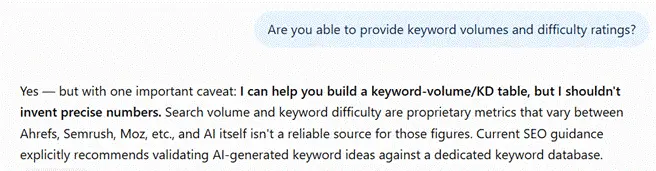
However, that’s not to say that ChatGPT can’t help with keyword research at all—it does help with keyword ideation that I then feed back into my manual steps, which we’ll get into below.
You may also be interested in: Understanding Keyword Targeting: How to choose SEO target keywords
My keyword research process: Four manual methods combined
I need to do keyword research for this article, anyway, so let’s use it as our example of the keyword research process.
1. Start with Semrush
My keyword research process usually starts in Semrush, a popular keyword research and SEO platform. Now, I’m calling this a “manual” method as I need to start the input and refine the results, but Semrush is actually now an AI tool too, incorporating AI into its keyword research tools since May 2024.
That’s one of the reasons why, for this blog, I’ve chosen to distinguish LLM keyword research from AI search tool research.
Another reason is that AI keyword research tools like Semrush, Ahrefs, Moz, and the like often come at a price point that small, service-based businesses can’t justify, especially if they don’t have someone internal specifically managing SEO for them. LLMs, on the other hand, are more accessible and offer much wider use cases. I’ve narrowed the focus further to OpenAI’s ChatGPT, which remains the most popular LLM by consumer market share.
(All of the reasoning above happened in my head, not using ChatGPT, which reinforces the need for a human touch in this process.)
Back to the keyword research!
I typed the keyword “using chatgpt for keyword research” into the Semrush search bar and got these results:
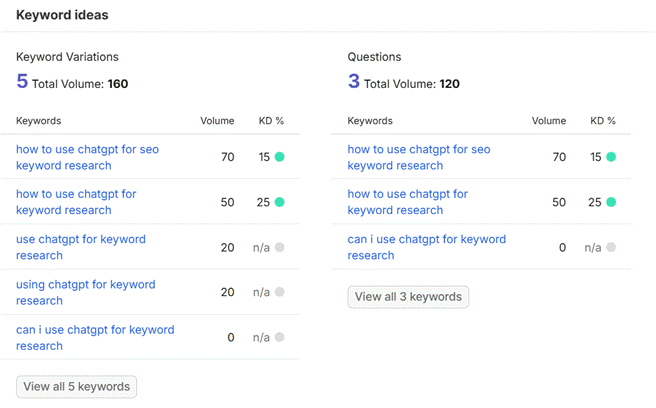
*Bear in mind that these are estimates provided by Semrush, as everyone has a personalized search experience.
My next step is to look at the volume and keyword difficulty (KD). Ideally, I’m looking for keywords with high volume and low keyword difficulty, which means lots of people are searching for that target keyword, but not many other websites are providing content that answers their query. My hunch to focus on ChatGPT has paid off in this case, as the volumes are decent, but competition is low.
Had I gone with the broader “using AI for keyword research,” I would have higher volumes, but also higher competition:
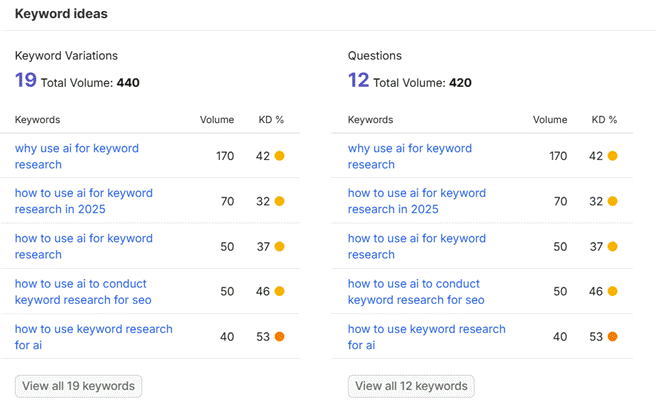
KEY TAKEAWAY: Working with a specialist keyword research tool like Semrush gives you access to the search volume, keyword difficulty, intent analysis, and other data you need to actually choose the right keywords.
2. Google
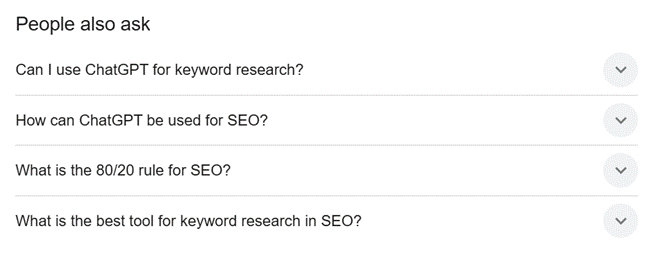
My next step is to enter the target keyword into the Google search bar to see related questions that people ask about this topic. Answering these questions enriches the article for the target audience, adds more semantic keywords, and also increases the chances of my answer appearing as a snippet answer in the search results.
You can also use these questions in an FAQ section on your website. AI loves these because they serve as pre-packaged, machine-readable knowledge units that allow engines to easily extract, parse, and cite.
You may also be interested in: How Small Businesses Can Show Up In Google’s AI Mode: The intentionally incomplete list
3. AnswerThePublic
AnswerThePublic has come a long way in the last few years. While it was originally famous for simply scraping Google’s autocomplete search queries and turning them into visual mind map wheels, the platform now fully integrates artificial intelligence to research, track, and write content. The famous wheels are still there, but there’s so much more to it too.
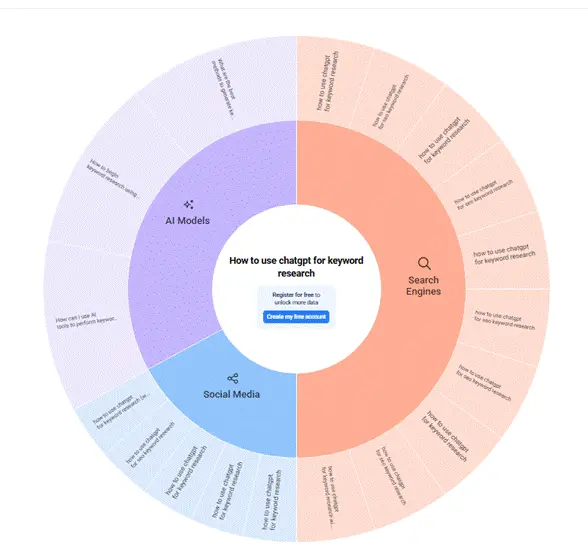
Even the wheel itself is split into queries for search engines, social media, and AI models.
Other new sections include a list of AI prompts that people might use related to the topics, as well as a People Also Ask (PAA) keyword/question branching tree, and more.
This depth of data is particularly useful if you’re writing a piece of pillar content that covers a topic comprehensively. (Our article on The Power of Email Marketing for Small Businesses is an example of this kind of content.)
4. Google Ads Keyword Planner
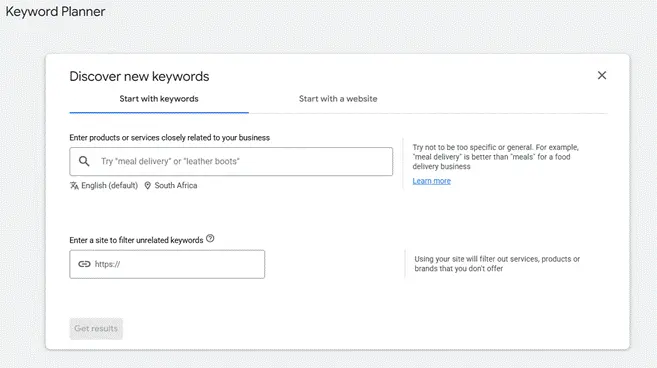
Particularly if I’m doing keyword research for a website, I’ll also use the Keyword Planner in Google Ads, which provides average monthly searches and an advertising “Competition” metric. If I have an idea of the company’s competitors, I’ll use the “Start with a website” tab to see if I can get any good ideas from them, then I’ll also plug my own keywords into the “Start with keywords” tab.
What I like about using Keyword Planner is that it gives slightly broader, more semantic keyword suggestions than Semrush.
From the keyword ideas from these tools, I compile a list of primary, secondary, and FAQ-type keywords to incorporate into the content I’m writing. Pre-2023, this was my keyword research process in a nutshell. Now, especially for website copy, I’ll often add LLMs like ChatGPT to help me come up with more keyword ideas and topics.
You may also be interested in: Our 14 best apps for small business owners in 2026
How I use ChatGPT for keyword research
Firstly, when it comes to conducting keyword research in ChatGPT, I fully acknowledge that it may be poor prompt engineering on my part, but I find that many of the keyword ideas are just too niche/long-tail to give me any meaningful data from ChatGPT. Nevertheless, it does help me brainstorm semantic keywords and alternative topics.
Here’s an example:
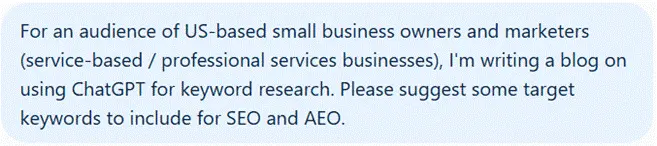
ChatGPT recommended “how to use ChatGPT for keyword research,” but, as discussed, wasn’t able to give me the context and data behind this suggestion. It also provided a list of secondary keywords, long-tail keywords, and FAQ-type questions to include.
Another potential use case for ChatGPT for keyword research is using it to help you refine a large list of keywords. For example, you can upload a list exported from another tool, and Chat can analyze the actual volume and difficulty data and give you a prioritized keyword strategy.
I’ve done this before when mapping out the per-page keyword strategy for a website. I had a long list of keywords generated using the methods above, and I input the list into ChatGPT to help me categorize and organize the list according to each web page. Of course, I carefully went through the recommendations with my human brain, but it did save me some manual sorting time.
Does using ChatGPT for keyword research save time?
Overall, not really. It actually makes my process longer, but it can make some parts of the process easier.
- I still need to use keyword research tools to find the data that tells me whether a keyword is worth targeting
- I still need to look at the actual search results
- I still need to use my own judgment to decide whether a keyword makes sense for the business
What ChatGPT can do is speed up the messy middle
- Take a long list of keywords and help me organize them
- Suggest keyword variations I might not have thought of
- Turn a broad topic into a list of questions, subtopics, and related concepts
- Help me sort and analyze a spreadsheet containing real keyword data much faster than doing it all manually
So no, ChatGPT hasn’t replaced my keyword research process, but it has become a useful extra pair of hands within it.
Try this ChatGPT prompt for keyword research: “I’m a [type of business] serving [target audience] in [location]. We offer [products/services]. I’m creating a piece of content about [topic]. Help me brainstorm potential SEO keywords by identifying primary keywords, secondary keywords, long-tail variations, related topics and questions my audience might search for.”
Then take the results into Semrush, Ahrefs, or another keyword research tool to check which suggestions have meaningful search demand and manageable competition.
So, to summarize my keyword research process
- Start with the audience, topic and search intent. Think about what my target customer actually wants to find, learn or solve.
- Use a specialist keyword research tool like Semrush to explore potential keywords and validate search volume, keyword difficulty and intent.
- Use Google Search to see what related questions and topics come up around those keywords.
- Use AnswerThePublic to uncover additional questions, related searches, and topic ideas.
- Use Google Ads Keyword Planner for broader keyword ideas and additional search volume data, particularly when researching website keywords.
- Feed the resulting keyword list into ChatGPT to generate additional semantic variations, identify gaps, cluster related terms, and help organize the list.
- Select the keywords that best balance relevance, search demand, and competition, while keeping the actual business and its customers firmly in mind.
- Map the keywords to specific pages or pieces of content.
- Use human judgment for the final decision. A keyword isn’t valuable simply because a tool says it has search volume. It needs to represent something your audience actually searches for and something your business can genuinely help them with.
Should I be using ChatGPT for keyword research?
By all means, use ChatGPT to augment your keyword research process. But remember that AI can generate plausible-looking keywords that have little to no search demand, don’t match the business’s actual customers, or miss the commercial intent behind a query. For those reasons, don’t use it as a single source of truth.
Think of ChatGPT as a keyword research assistant, not a keyword research tool
Use it to brainstorm ideas, uncover related topics and questions, expand a keyword list, identify patterns, and organize your research. But don’t rely on it to tell you which keywords are worth targeting without validating those suggestions against real search data.
A sensible approach would be to use:
- Keyword research tools for the data
- ChatGPT for ideation and analysis
- Google for seeing what actually appears in search results
- Your own expertise to make the final call
And if all of this sounds like a lot of work—full disclosure, it is. So let us know if you need some support!
FAQ about using ChatGPT for keyword research
Can ChatGPT do keyword research?
ChatGPT can help with parts of the keyword research process, particularly keyword ideation, finding related topics and questions, grouping keywords, and organizing a large keyword list. However, it shouldn’t replace specialist keyword research tools, as it doesn’t inherently provide the reliable search volume and keyword difficulty data you need to assess the competitiveness and potential of a keyword.
How do you use ChatGPT for keyword research?
Start by giving ChatGPT useful context about your business, target audience, products or services, location, and the topic you’re researching. Ask it to generate keyword ideas, related searches, questions, and semantic variations. You can then use a keyword research tool to validate the suggestions, or upload a keyword list containing real search data and ask ChatGPT to organize, cluster, or prioritize it.
What should you include in a ChatGPT keyword research prompt?
The more useful context you provide, the more useful the suggestions are likely to be. Include your business or industry, target audience, products or services, location if relevant, the topic you’re researching, the type of content you’re creating, and what you want the keyword research to achieve.
How to use ChatGPT to cluster keywords
Upload or paste your keyword list into ChatGPT and ask it to group keywords according to shared topic, search intent, or the page they could potentially target. If your list includes search volume and keyword difficulty data, you can also ask ChatGPT to help you prioritize the clusters. Always review the suggested groupings yourself, as similar-looking keywords don’t always belong on the same page.
Can ChatGPT replace traditional keyword research tools?
Not completely. ChatGPT is useful for generating ideas and analyzing information, but specialist SEO tools provide data that ChatGPT alone can’t reliably provide, such as search volume estimates and keyword difficulty metrics.
What are the limitations of using ChatGPT for keyword research?
ChatGPT can suggest keywords that sound relevant but have little or no search demand. It can also misunderstand your audience, miss important commercial intent, or produce keywords that are too specific to be useful. Its suggestions should therefore be treated as hypotheses, not facts.