
“SEO IS NOT DEAD,” we’ve been screaming from the rafters in the AI era.
A recent Search Engine Journal article echoed the same in relation to Google’s new AI Mode. The article was interesting, but I didn’t find it actionable enough for small businesses, which is why I’m writing this guide to give small businesses some simple (albeit, not always easy) ways to give their content a better chance of ranking in AI mode.
| Key takeaways 1. Google’s AI Mode changes search from a list of links into an interactive research experience 2. Ranking in AI Mode still depends on strong SEO fundamentals like helpful content, structure, and user experience 3. Original perspectives, real expertise, and firsthand experiences matter more than generic AI-generated content 4. Small businesses can compete by creating niche, audience-specific content |
What is Google’s AI Mode?
Google’s AI Mode is a new search experience that combines conversational AI with traditional web browsing. Instead of showing only a list of links, AI Mode lets users research topics, compare information, and ask follow-up questions while viewing webpages side-by-side.
When you start a Google search on Chrome desktop, you’ll see an option on the right to search using AI Mode:
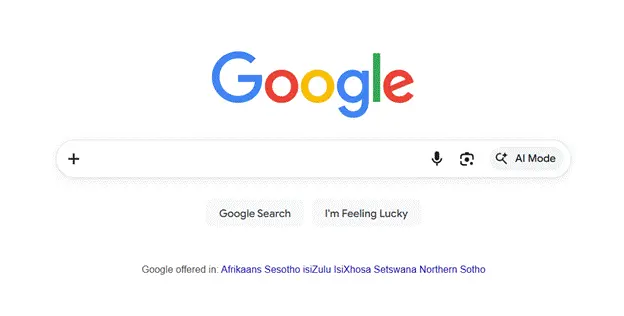
How AI mode works:
- Keeps the chat open while you browse websites, so you can read a page and ask questions about it at the same time
- Clicking a link no longer takes you away from the AI conversation—the webpage opens beside the AI panel
- You can ask follow-up questions about the page without starting over or switching tabs
- A new “plus” menu lets you add open tabs, PDFs, and images directly into an AI search
- Multiple tabs and files can be combined into one search for deeper research and better answers
According to Robby Stein, Google Search’s VP of Product, and Mike Torres, Google Chrome’s VP of Product, this update makes it easier to “access and engage with content and dive deeper into what you find, all without losing your place or needing to switch tabs.”
See how AI mode works:
AI Mode is great for users, not so much for website clicks
As you may have already noticed with AI Overviews, the way we search is moving from a list of links to a concierge-style experience. Now, for many searches, users can accomplish exactly what they need without leaving the search page.
Having worked with SEO for a while, I’ve always viewed climbing the rankings (moving higher up the list in the search page) and getting clicks as the metrics that matter. But I feel like nowadays there’s barely any space on the search page for traditional listed results! As the SEJ article says, “the click is no longer the beginning of discovery. In many cases, it’s the moment of verification.”
You can see how this plays out if you go back to the coffee machine example from the video. All the research is happening on the Google search page. It’s only when the person feels ready to buy that they might actually click on a link to complete their purchase.
What does this mean for businesses trying to attract customers on Google?
Firstly, it’s not all bad news. Yes, clicks and rankings have always been important for SEO performance, but what really matters is what moves the needle for that particular business, depending on their goals. If the goal is website leads or sales, then the volume of clicks is less important than the volume of form fills or completed carts. So, if AI Mode means you’re getting fewer clicks but more conversions, that’s a win.
AI Mode might also give the underdog site a better chance of showing up. Traditional search listings are ranked on hundreds of signals, trust being a biggie. But trust is partly measured by things like online brand mentions, domain age, press coverage, and other factors that aren’t easy to come by as a small business. That meant that it often became nearly impossible to outrank the big dogs.
The key question then becomes:
How do I get my website to rank in AI Mode?
Honestly, the more things change, the more they stay the same. As Google has developed its ranking algorithms over the years, it’s gotten better and better at identifying and rewarding quality content and a good user experience. AI search is no different: it’s looking to serve content that’s original, relevant, helpful, and clearly structured.
If you were looking for tricks, you’ve come to the wrong place. It’s really as boring as that. (I say boring facetiously, of course. I love that good SEO and Answer Engine Optimization [AEO] are actually really simple.)
“AI Mode compresses the margin for mediocrity”
My top quote from the SEJ article.
Once you have the basics covered (such as a clear structure, schema, a fast site, helpful content that’s easy to skim and understand—yes, these are basics now), you need to ask yourself: “What am I providing the user that can’t already be found on the web and crawled by ChatGPT?” It’s simple, but it’s not easy. With billions of other websites out there, how do you offer something truly unique? And if you’re a small business without the benefit of a massive content team, where do you fit in?
It’s a question I need to ask myself multiple times a day as I create content for our agency as well as our clients—all small businesses, all trying to do the best we can with what we have. So, I’ve come up with a list of tactics that can help you create a piece that can’t just be summarized into obscurity. The list is by no means exhaustive, but it’s intended to be achievable for small businesses operating with leaner resources.
The (intentionally incomplete) small business checklist to rank in AI Mode
- Include an opinion or a unique point of view that adds value to the conversation
- Share your expertise; ChatGPT can’t replicate all the mini-narratives that have got you where you are today
- Write for a specific target audience (don’t be afraid to go super niche)
- The same goes for content topics—pick a lane, and stick to it; I promise the rest of us aren’t bored
- Lead with a story, relatable anecdote, or firsthand experience
- Include some proprietary data (it doesn’t have to be a nationwide survey; share some of your own company data to prove a point)
- Repurpose your content across all the platforms you use—newsletter, blog, Google Business, social media, etc.
- When in doubt, produce less content, but make it better
Do you see the pattern here? None of the above can be outsourced to an LLM.
Disclaimer: There’s much more you can do to improve your visibility in AI Mode, but I’ve purposefully kept this list short to avoid the inevitable overwhelm of tactics that feel out of reach for small teams. Here’s a more comprehensive resource if you want to dive deeper.
Small businesses can still have an edge in the AI era
To me, the biggest takeaway from AI Mode is this: small businesses don’t need to out-publish the internet—they need to be more human than it. The brands that will stand out are the ones with a clear point of view, real expertise, and content that helps people make decisions.
That’s good news for small businesses. You don’t need a giant marketing team or endless AI-generated blog posts to compete. You just need a smarter content strategy, a strong understanding of your audience, and the confidence to create content only your business could create. If you want help creating content that’s built for both humans and AI search, we’d love to hear from you.
You may also be interested in: